Adopted not embedded: AI, productivity and uneven gains for women entrepreneurs
Research report on the use of AI by women entrepreneurs.

Our latest report, “Adopted not embedded: AI, productivity and uneven gains for women entrepreneurs”, in partnership with Intuit and the World Bank’s “Women, Business and the Law” project, and supported by Team Lewis Foundation, explores the use of AI by women entrepreneurs.
The report draws on a global survey of 3,072 women entrepreneurs across 66 low and middle income countries (LMICs). The survey captures the experiences of a specific segment of women entrepreneurs in LMICs: those who are digitally connected and relatively well educated. Nearly two thirds of respondents have post-secondary education, and all are active online.
It found that artificial intelligence is already delivering meaningful value for many women-led businesses and offers an opportunity to level the playing field for firms with fewer resources. However, while adoption is already widespread, deeper integration remains uneven. This difference will shape who realises sustained business growth.
In addition to the full report below, you can read a shorter report summary.
Adopted not embedded: AI, productivity and uneven gains for women entrepreneurs
Download now (2.3MB pdf)
DownloadAdoption has scaled rapidly
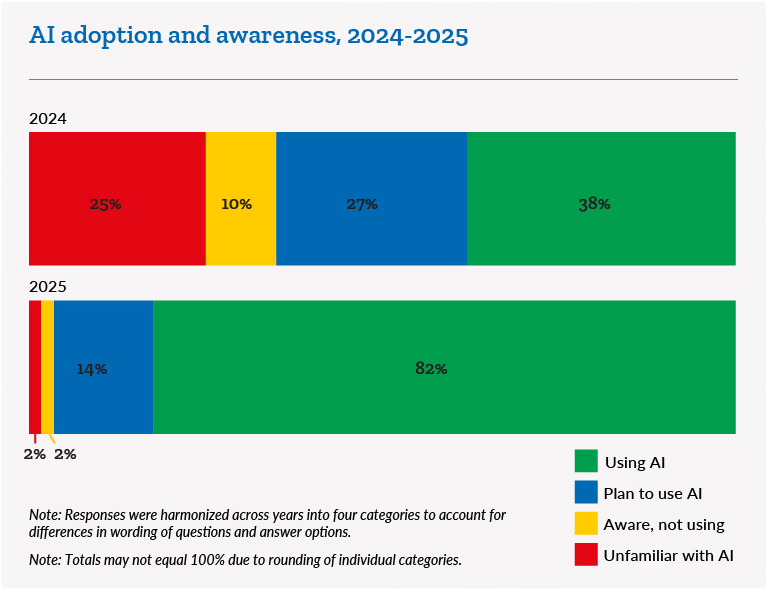
AI use among digitally connected women entrepreneurs has more than doubled in a single year — rising from 38% to 82%, with 45% now using these tools daily.
AI has moved from novelty to routine business infrastructure, embedded into everyday tasks such as communication, customer engagement and content creation.
For women-led micro and small enterprises, AI is placing capabilities like writing, design and data analysis within reach — expanding what small businesses can achieve without hiring additional expertise.
With AI, I am able to do tasks myself that, without AI, I would have had to hire someone else to do.
AI is delivering immediate and tangible benefits
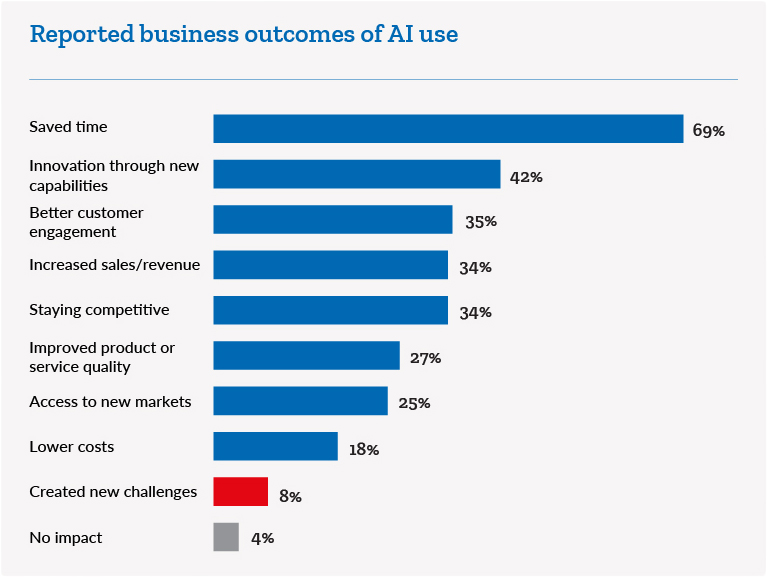
Time savings are the most widely reported benefit, cited by 69% of respondents. AI is reducing administrative burden and freeing women to focus on strategy, customer relationships and product development.
These gains are particularly significant given that respondents spend an average of 18 hours per week on caregiving alongside running their businesses — AI is helping women maintain business performance under real pressure.
Beyond time, 42% cite innovation through new capabilities, 35% report better customer engagement and 34% report increased sales — demonstrating AI’s potential to expand what small businesses can achieve with limited resources.
The biggest benefit is that AI makes tasks easier and saves time, especially in research, organising information, and completing work quickly and accurately.
Time savings are widespread, but growth gains are uneven
Despite broad adoption, AI’s impact on business growth remains uneven. For many women entrepreneurs, AI is easing operational pressure rather than enabling expansion — improving how businesses run within their existing capacity, not beyond it.
Outcomes directly linked to scaling — revenue growth, cost reduction and market expansion — are reported far less consistently than time savings, which may simply be absorbed into existing workloads or caregiving responsibilities.
With AI, tasks like writing, designing, and data entry take much less time, allowing me to focus on strategy and customer relationships.
Where AI is used matters for business outcomes
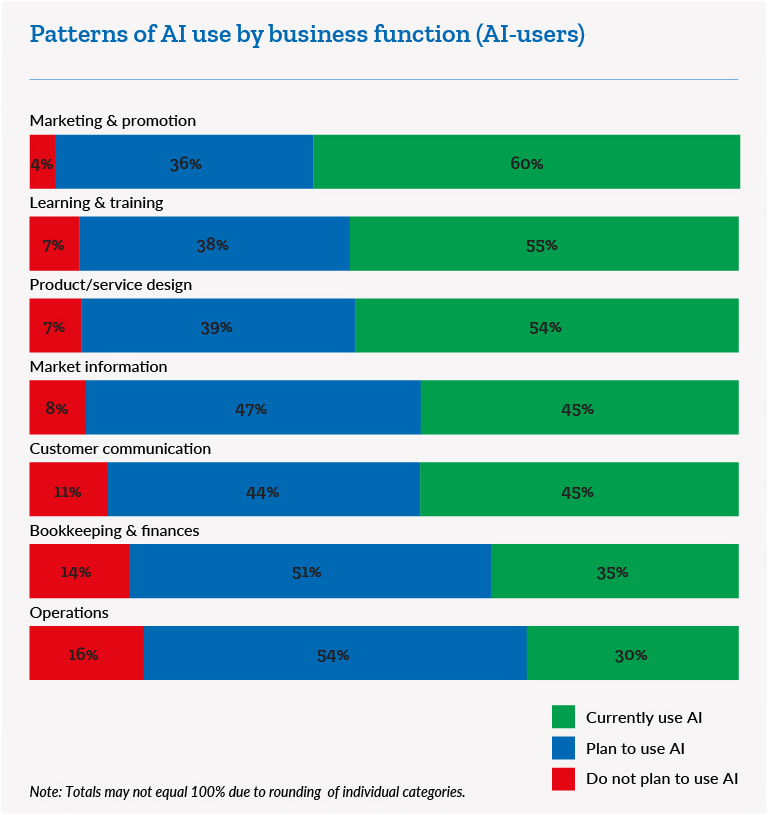
AI adoption is concentrated in lower-risk, front-facing functions — marketing (60%), learning (55%) and design (54%) — where it delivers quick, visible results. Adoption remains far lower in back-end functions most closely tied to business performance: only 35% use AI for bookkeeping and 30% for operations.
This gap has significant consequences. Women who use AI in finance and operations are roughly 1.8 times more likely to report increased sales or revenue than those who use it only in other areas.
Most AI tools today are siloed… A central, predictive system that connects all areas of the business would save time and make strategic decision-making much easier.
Skills, confidence, trust and time shape how deeply AI is used
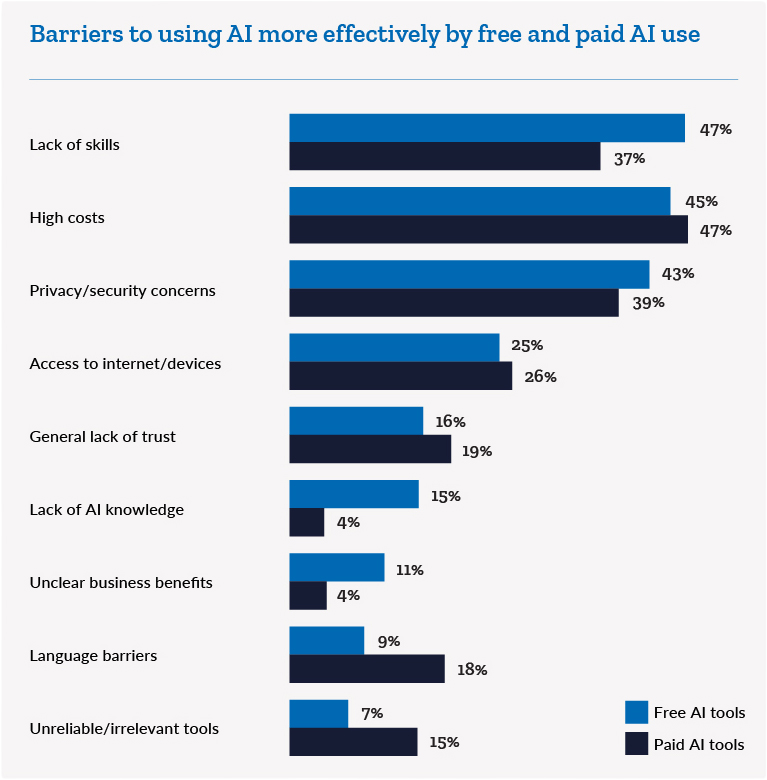
The price is no longer the primary barrier for surface-level adoption — 41% of respondents already pay for at least one AI tool. However, for deeper integration the obstacles now are high costs (46%), lack of skills (43%) and privacy or security concerns (41%), reflecting a gap not in interest but in the conditions needed for confident, effective use.
Time constraints compound the challenge. Women balancing caregiving and business responsibilities may lack the hours needed to experiment with new tools and embed AI into core operations, even when the motivation is there.
The biggest challenge for me has been learning how to use AI tools effectively and understanding which ones are truly helpful.
Without deliberate action, AI may reinforce existing inequalities
High adoption rates conceal important differences in who benefits most. Women with more time, stronger skills and greater organisational capacity are better positioned to integrate AI deeply — while those with fewer resources risk being confined to lighter, episodic use.
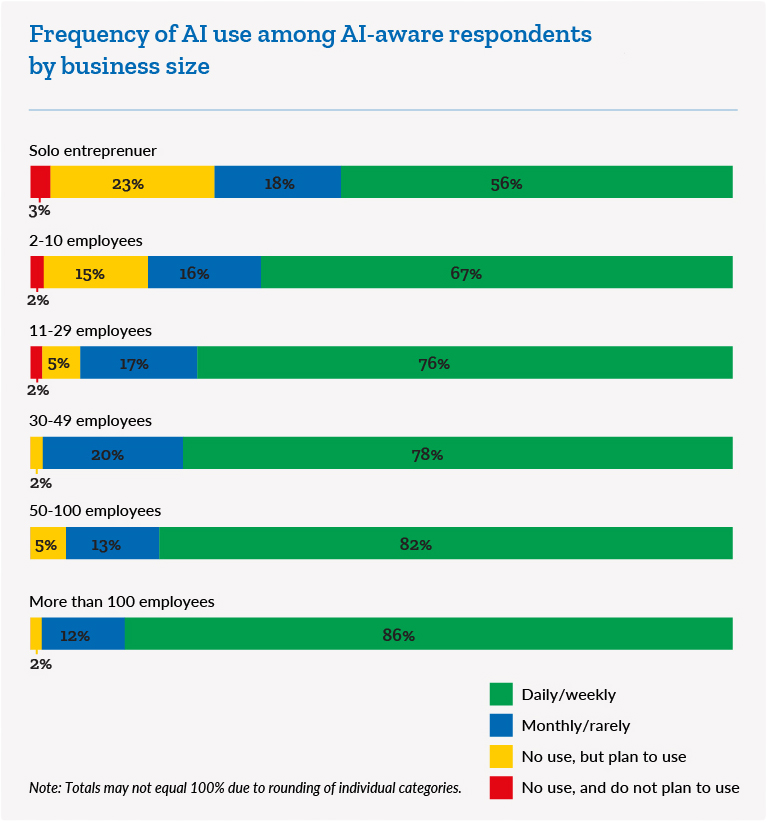
This is already visible by business size: 86% of entrepreneurs with more than 100 employees use AI daily or weekly, compared to just 56% of solo entrepreneurs. Without targeted support, these gaps risk widening over time.
The biggest challenge is the mental load of constantly context-switching… tools and systems that reduce friction would make the biggest difference.
Recommendations
For governments and regulators
- Shift from access to integration. Move beyond tracking awareness and adoption — measure whether AI is embedded in finance, operations and planning, where productivity gains are most likely to translate into growth.
- Invest in applied capability. Embed function-specific AI training into MSME and vocational systems, with a focus on bookkeeping, cash flow management and operational decision-making.
- Make trust visible. Strengthen data protection, transparency and accountability frameworks so women entrepreneurs can confidently use AI in higher-stakes business functions.
For AI providers and technology companies
- Design for small-firm realities. Build tools that work reliably on low-cost smartphones and low bandwidth, and that integrate with platforms women already use, such as WhatsApp and mobile money.
- Reduce cognitive load. Simplify onboarding and provide guided workflows that support the whole business — from customer-facing activities through to financial management.
- Improve language support and accuracy. Invest in local-language capability and bias reduction so that outputs are reliable and business-ready.
For multilaterals, donors and funders
- Fund integration, not just awareness. Prioritise programmes that support workflow-level AI integration into core business systems, rather than one-off tool introductions.
- Reduce learning costs. Co-finance trial periods, coaching and connectivity costs so women entrepreneurs can test AI tools in finance and operations before committing scarce resources.
- Measure business outcomes. Track whether AI contributes to revenue growth, cost control and business resilience — and monitor who is benefiting, not only who is adopting.
Adopted not embedded: AI, productivity and uneven gains for women entrepreneurs
Download now (2.3MB pdf)
DownloadIn partnership with...

You or your company can help bridge the divide
-
Become a mentor
Become a vital part of a woman's business success story.
Read more
-
Corporate and Institutional Partnerships
Purpose-designed collaborations that advance women's entrepreneurship.
Read more
-

Become a mentee referral partner
We're always looking for mentee referral partner organisations to work alongside.
Read more